
From Understanding to Action and What It Takes from Childhood Onwards
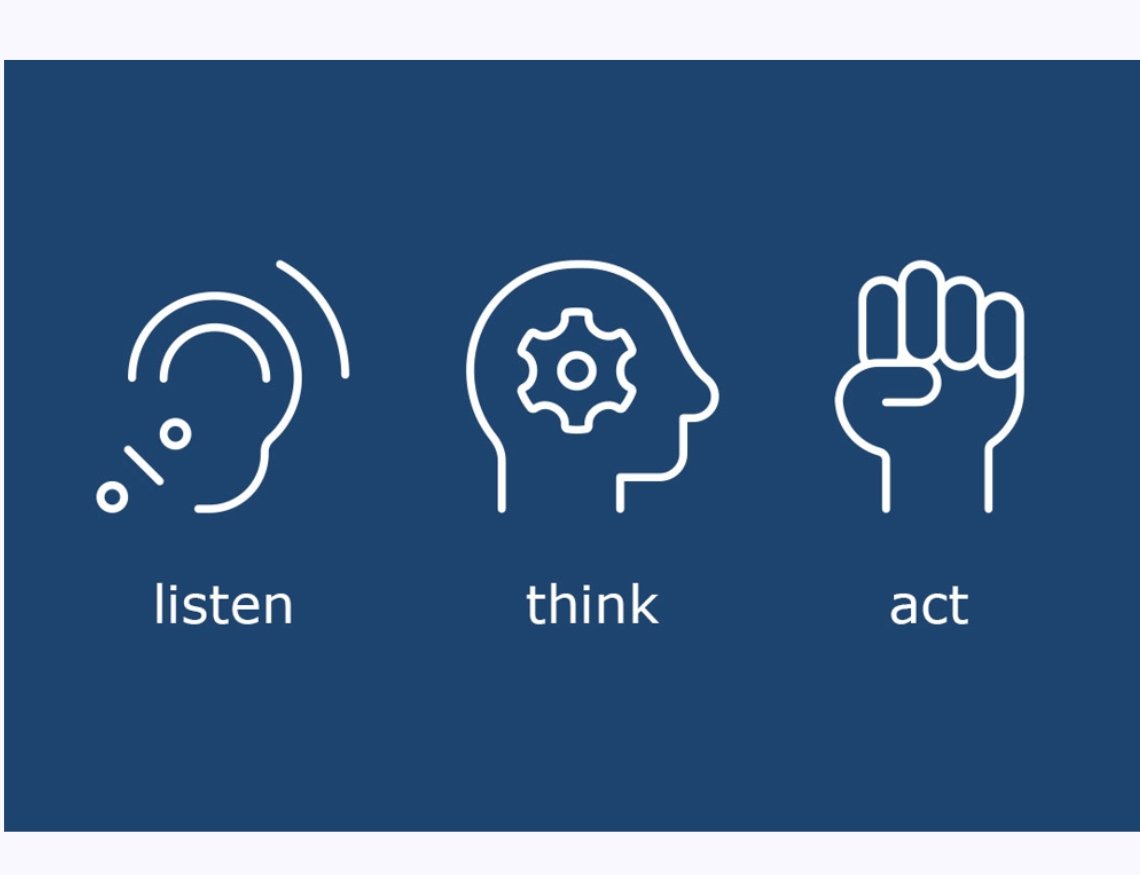
Violence prevention model: listen, think, act.
Harald Haarmann and Monika Matscheko
Is familiarity with non-violent coexistence a given?
No, unfortunately not. At what age does a person become aware of how valuable and important socially responsible thinking and acting are?
Perhaps at school? That's too late. These days, it's clear that the behavior of students reflects the tensions in our society. Rivalries, bullying, and macho posturing poison the atmosphere in the schoolyard and classroom.
Perhaps in adulthood? That would be quite late, but still possible. It makes sense to develop an awareness of the value of balanced, non-aggression-related social interactions early on, ideally within the family and during preschool.
What does "ideally" mean?
When you consider the reality of social conditions in everyday life, you realize that a conflict-free family life is not a given; in many neighborhoods, it's more the exception than the rule. Moreover, global political crises, rising living costs, and the resulting disorientation and uncertainty in both private and professional life make peaceful coexistence more difficult.
It becomes clear that skills for non-violent interaction should be practiced and developed as early as possible, in keeping with the saying, "Practice makes perfect" ("Wilhelm Tell," Friedrich Schiller, Act 3, Scene 1). However, any comparison is somewhat flawed. Wilhelm Tell is about learning to shoot, which is certainly not part of the repertoire of peaceful coexistence. But the basic message is certainly true: it is important to practice social peacefulness even in early childhood.
The responsibility for this lies not only with teachers, but also within the family, i.e., with parents or those responsible for the children's upbringing. Ideally, they lay the groundwork, which should be compatible with the goals of daycare and kindergarten. School education can then build upon these acquired fundamental skills.
Many people, especially those working in education, have long been aware of the importance of educational goals that strengthen personality and foster community, but a widespread trend in this direction has not yet emerged. There are promising approaches in early childhood education and primary school that, with their violence prevention programs, lay the foundation for the aforementioned goals.
Examples of already evaluated programs include:
• Faustlos for kindergarten and primary school. Read more!
• Anti-bullying program based on Olweus at the school, class, and individual levels:
Olweus, Dan (1995): Violence in Schools: What Teachers and Parents Should Know and Can Do. 2nd edition 1996. Bern: Hans Huber Publishers.
• Peacemaker Training for all students in a class
Gasteiger-Klicpera, Barbara / Klein, Gudrun (2006): Peacemaker Training. Primary school program for violence prevention. Munich: Ernst Reinhardt Verlag.
• The WiSK program with measures at the school, class, and individual levels
Strohmeier, Dagmar / Atria, Moira (in press 2009): WiSK Program. Promoting social and intercultural competence in schools. Münster: Waxmann Verlag
Other effective initiatives include:
• Peer mediation (conflict resolution program or conflict mediator model). Find out more!
• Buddy projects: Faller, Kurt / Kneip, Winfried (2007): The Buddy Principle – Systematic Social Learning. Düsseldorf: Buddy e.V.
• PFAD (Program for Promoting Alternative Thinking Strategies). Read more!
Interested parties can find additional information from this link.