
When does prehistory end and history begin? - Old Europe in the crucial role of tipping the scales
Harald Haarmann
Saara Metsäranta
One way to distinguish history from prehistory is to examine whether there are written sources or mentions from the period. The emergence of history thus requires the invention of writing. Writing, in turn, arose from the need to record and convey messages. Thus, signs of writing can be distinguished, for example, from ornaments, which exist more for aesthetic reasons. Writing represents something; its task is to carry meaning that can be read and reproduced. Writing developed for practical needs of religion and social structures, such as keeping calendars and bookkeeping, archiving, creating and transmitting religious rituals and doctrines.
A more central and broader defining factor in distinguishing history and prehistory is the concept of civilization. Civilization refers to a high culture, or a high cultural identification and expansion. However, the definition of civilization is not neutral or unbiased. For example, the still common saying in our everyday language: "You are from the Stone Age!" refers to the notion that the opposite of civilization is so-called prehistory, hunter-gatherers, and other wilder communities. The scientific paradigm, i.e., the prevailing way of structuring knowledge and thinking, defines what we consider high cultural activity and what we do not.
Recent research with modern methods has provided much information about ancient civilizations. With increasingly extensive research knowledge, we should refine and expand our understanding of which cultures belong to the ancient civilizations that existed before antiquity. Read more about development of humanity and early civilizations.
When looking at achievements that were born long ago in Old Europe (the Danube civilization, respectively; c. 6000 BCE), "a time long considered prehistoric," one can only marvel at how ingenious people were already a couple of thousand years before the emergence of Mesopotamian or ancient Egyptian cultures. The cultural sphere of Old Europe included the present-day Balkans, western Ukraine, and Greece. Among the early inventions found from this area, the following innovations have been identified:
- use of the plough in fieldwork;
- potter's wheel;
- two-chambered kiln used for pottery and metal casting;
- casting of metals (copper, gold);
- two-story houses;
- shipbuilding skills (for navigation);
- large cities, which according to archaeologists housed 7,000 or even over 10,000 people;
- literacy; (Read more about how Europeans were writing 2000 years before the Sumerians)
- calendar for timekeeping.
When researchers are asked whether these achievements are indicators of history or belong to the prehistoric era, the answer is unanimous and unequivocal. These achievements represent the level of historical development. They clearly differ from prehistoric periods. Of course, there is no doubt about this. Nevertheless, in the study of civilizations, achievements in Mesopotamia, Ancient Egypt, Ancient China, and the Ancient Indus culture are thematized, but Ancient Europe usually remains outside the researchers' focus.
Until today, the period when Old Europe flourished (6000-3000 BCE) is classified as prehistory, and it is claimed that history in Europe only began in the Bronze Age (around 3000 BCE). David Graeber and David Wengrow state in their book “The Dawn of Everything” (2021): Researchers of civilizations have still not taken into account that the world's oldest large cities emerged in the area of Old Europe (present-day Western Ukraine and Moldova).
Why is the era of Old Europe overlooked, even though the aforementioned achievements flourished there and the period shows high cultural features belonging to civilization?
It may be that one factor prevents direct contact with the categorization of Old Europe and also explains scientists' reluctance to engage with this subject. According to the traditional schematic definition, the level of civilization development is achieved under the following conditions: The culture has a social hierarchy (poor-rich, women-men, etc.), elite power, and structures referring to a state (rulers-subordinates). This definition applies when thinking of Mesopotamia, Ancient Egypt, or Ancient China. But the schematic definition does not apply when talking about the Old Indus civilization, which is accepted among civilizations. The mentioned criteria are missing there.
The Old European community also operated without social hierarchy, elite power, or state structure, even though all the other innovations mentioned above had been achieved.
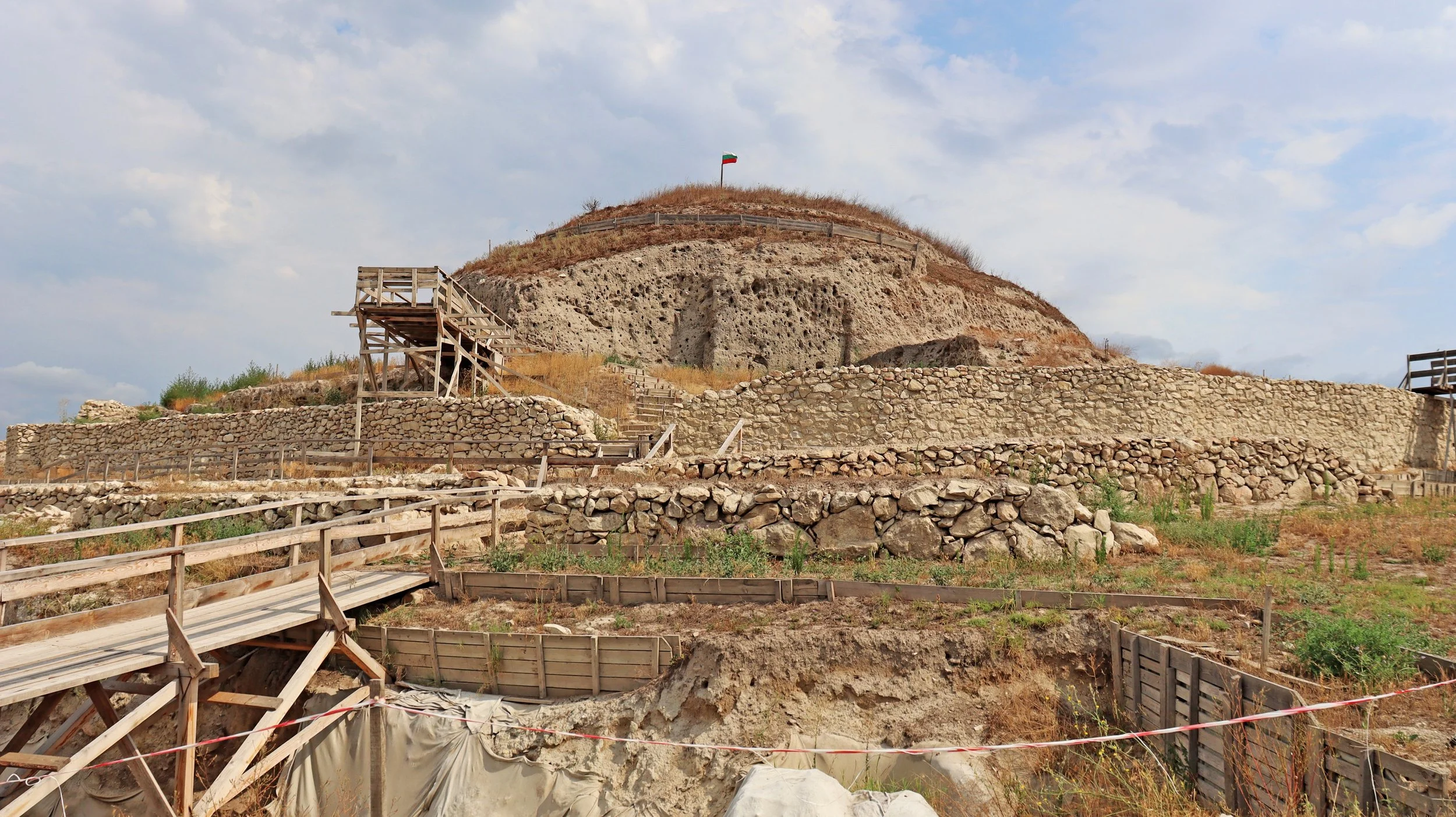
Archaeological site Solnitsata is located in the Balkans. This city has existed since the fifth millennium BC. It was enclosed within a thick stone wall. The population of the city is estimated to have been over 300. It is believed that city was built around salt production, which was an important trade item.
The Old Indus civilization and Old Europe were economic communities whose development was promoted by a wide and successful trade network. The trade network of Old Europe was the world's first extensive trade network, stretching thousands of kilometers and connecting hundreds of settlements. Goods were transported by land, along rivers, and by sea using ships and boats. Trade enabled the development of wagon and shipbuilding skills. What makes the trade of Old Europe exceptional is that trade was conducted without the pursuit of individual gain and the accumulation of wealth for specific social groups. Trade was communal and based on sharing, barter, good and peaceful relations. Along with the merchants, business gifts were also spread, given during trade to maintain good relations with trading partners. Economic development was therefore not based on social inequality, as is conventionally thought. We are used to thinking that trade benefits the elite and accumulates wealth only for a few selected ones. This is part of the conventional definition of high culture. (Read more about trade in Old Europe)
Despite a broad and highly developed trade culture, the civilization of Old Europe is not regarded in the same way as the Old Indus civilization in historical writing, where the Old Indus civilization is honored with the status of civilization. Why use two different measures when talking about phases of cultural history? Could trade, based on an egalitarian community economy, also be considered high culture? There would be good reason to abandon outdated stereotypical views and adopt new ways of thinking.
Today, there is abundant evidence and documentation available. Scientific research stays up to date when patterns and perceptions are allowed to evolve freely without prejudices. Based on new extensive research data and reliable proven results, our understanding of history and its civilizations is complemented and definitions remodeled.
REFERENCES
David Graeber, David Wengrow 2021: The dawn of everything, Allen Lane.
Harald Haarmann: “The rise of civilization and the beginning of history in Europe - Deconstructing outmoded concepts of ‘prehistory’ In Zeitschrift für Balkanologie 58 (2022). p. 85-97.
Harald Haarmann 2019: “Mystery of the Danube Civilisation – The discovery of Europe´s oldest civilisation, Marix Verlag.