
From the dialogue between Diotima and Socrates: Love is the elixir of life and the driving force of philosophy
Harald Haarmann
Saara Metsäranta
In the literary tradition of antiquity, we find clues to how people experienced their everyday life, what they considered important for their well-being and how they constructed social relations. Among those who have broadly laid out, in their writings, a panorama of such topics, there is one philosopher who stands out, and this is Plato (c. 427 - c. 347 BCE).
There is general agreement that Plato's concept of love and related concepts such as the good and beauty is most comprehensively treated in his dialogue Symposium. In Plato's dialogue Symposium, Diotima is introduced by Socrates as the wise woman. Socrates speaks of Diotima as his teacher in matters of the philosophy of love. Diotima of Mantinea is one of the few female protagonists in Plato's work. In the central speech given by Diotima on the nature of beauty (Symposium, 201d - 212a), embedded in the words of Socrates, echoes the initiation ritual of the Eleusinian mysteries where the two realms, the world of the mortals and the world of the immortals (i.e. of supernatural beings) are bridged.
The Eleusinian Mysteries were a major religious tradition in ancient Greece, centered on the worship of the goddess of agriculture, Demeter, and her daughter Persephone. These mysteries were held in the city of Eleusis, about 14 kilometers from Athens. They formed a vital part of Greek spirituality, and were characterized by secret rituals and initiations that promised participants a rewarding afterlife.
Plato is known for the separation of Forms from perceptible things. Plato, through Socrates, makes Diotima speak as if she were present (Symposium, 210a-212a), thus highlighting the significance of the message she conveys: "Diotima is here describing at length the Form, the Beautiful" (Dancy 2009: 83).
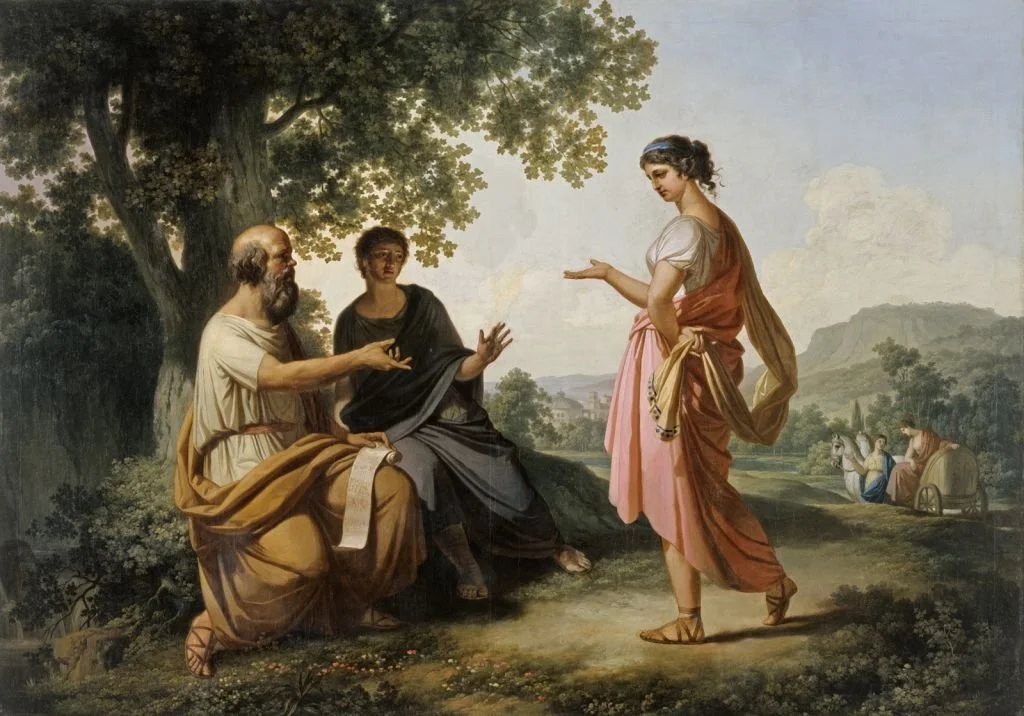
The Symposium provides much space for the philosopher to elaborate on the concept that became known to posteriority as 'Platonic love'. Eros, in its ideal sense, is "the nostalgia of the Absolute" (Reale 2001: 157), the force that inspires us to return to the absolute state which brings us near the gods. In Diotima's speeches, Eros is neither god (god does not need to pursue goodness, he already is) nor man, but something in between. In the same way that a wise man does not need philosophy, and on the other hand, a fool ignores wisdom and does not seek to understand it. The philosopher is somewhere in between, in the same way that communication and interaction between god and man takes place through the spirit and language, this same state of connection is needed when the philosopher seeks wisdom.
If the state of closeness to the gods (wisdom, goodness, beauty) is absolute, it is the essence of goodness. Eros leads us to perceive beauty, which is imprinted on our minds as a form which is immortal and continuity. If then this state of nearness to the gods is the absolute, then this is the essence of goodness. Eros directs us to perceive Beauty that is imprinted in our mind as form.
The focus of the problem area where aesthetic and philosophical currents intersect is the concept 'love'. Depending on an individual's inclination, love may be an (exclusively) erotic experience on the level of the senses, but it may also appeal to the aesthetic sense, and the object of one's love becomes beautiful in the eye of the beholder.
We love what feels or looks good. The object of love as an aesthetic sense can also be an object, a person or a thing, it can also be acquired knowledge. When we love, we reach out to it because it makes us happy. The object of love becomes beautiful in the eyes of the beholder. The philosopher takes a step forward in his pursuit of wisdom, he loves the immortal. Love leads him from the perception of beauty and the desire for wisdom: "For wisdom is the most beautiful thing, and love is the love of beauty, so must love be philosophical?..." (Diotima in the Symposium, 204b2). The philosopher follows in his pursuit of wisdom, in this intermediate state (of Eros), he strives to develop his thinking as if he were pregnant and giving birth. He pushes his thought towards fuller knowledge together with others. Loving this process, which gives him the experience that his thoughts will reproduce and develop after him and are further shaped in the minds of many towards fuller knowledge.
REFERENCES
Jean-Luc Nancy, Le plaisir au dessin (2009)
Platon, Symposium, translation by David Horan in The dialogues of Plato (2025)
Giovanni Reale, Il pensiero antico (2001)